How it runs
Hosted
A managed service. Nothing to stand up, nothing to maintain. Your artists get a URL and a plugin, and the library is there when a new hire opens the editor on their first day.
Self-hosted
The same registry on your own metal. Unannounced titles and licensed IP never leave your network: catalog, previews, and storage sit behind your VPN, next to the version control you already run. Your security team holds the keys.
Air-gapped
Enterprise runs fully offline, on hardware you own, for the work that can't touch the internet at all. Nothing phones home.
The desktop app keeps a local working copy in every deployment: browse and search offline, sync when the network is back.
- Training
- Never on your assets. Search runs a fixed model that reads your previews; nothing you upload teaches it.
- Tenancy
- Dedicated instance from Studio up. Your catalog runs alone.
- Storage
- Bring your own bucket from Studio up. Your cloud, your keys.
- Access
- Single sign-on on every plan, the free one included. SAML and OIDC, with SCIM from Studio.
- Transfer
- Unlimited in and out, every plan. We meter bytes at rest, never the wire.
- Exit
- Full export the day you want it. It costs nothing to pull.
- Air gap
- Enterprise runs offline on your hardware. Nothing phones home.
Every asset has a paper trail.
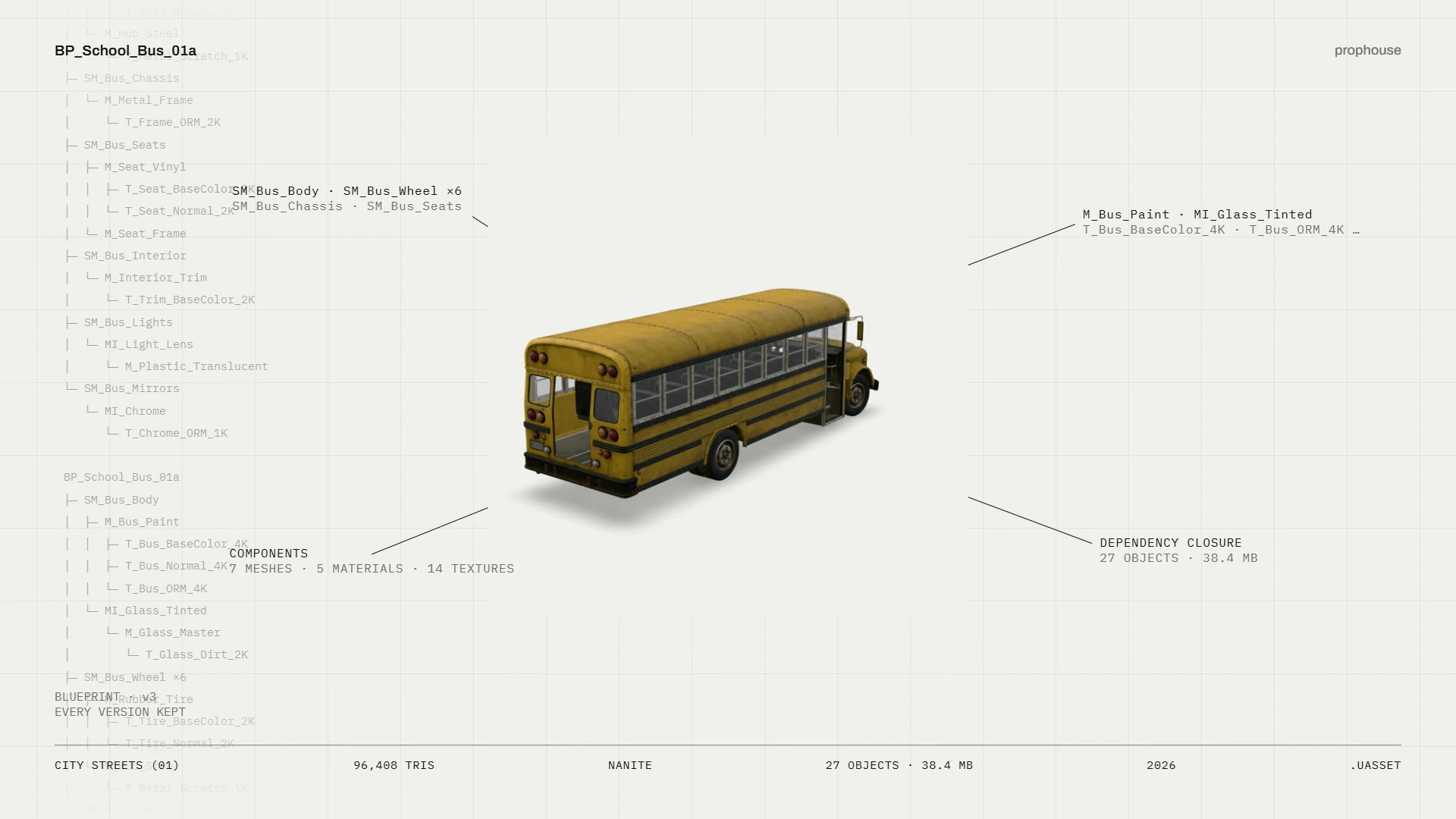
Every mesh gets a textured 3D preview you can spin in the browser before you pull down a gigabyte. Under it sits the rest of the record: the people who have touched it, who owns it now, who holds the lock, the projects already shipping it, and every material and texture it drags along behind it.
- Asset
- SM_Warehouse_Crate_01
- Version
- v4 · 3 prior, diffable
- Variants
- clean · weathered · burned
- Geometry
- LOD0 · 4,812 tris · Nanite
- Tags
- nanite hero-prop industrial modular
- Authorship
- D. Reyes · v4 retopo · Apr 2026
M. Okafor · v2 uplift · Nov 2025
Fab · v1 import · Aug 2025 - Owner
- D. Reyes · answers for changes
- Lock
- held by D. Reyes · since 09:41 · v5 in progress
- Used in
- Harbor Line · shipped
Nightshift · in dev
Check it out. Check it back in.
Lock an asset before you touch it. The catalog shows who holds it and since when, so nobody pushes over your work and no one ever merges a mesh.
Every entry also names an owner: the person who answers "can I change this?" One ping instead of a channel dig.
The verdict lands on the version.
Send an asset to up to twenty reviewers. Each one approves or requests changes, the fix routes to a named person, and the verdict pins the exact version it was made on. "What did we approve" has an exact answer, months later, in writing.
Reviewers draw on the render with pen, arrows, boxes, and text, or pin a note to a spot on the 3D model with their camera angle saved. @-mention anyone and it reaches their inbox and their desktop.
Every office pulls from up close.
Assets are served from the network edge, close to every office and every remote artist. A pull in London runs as fast as one in LA, and the outsourcer on another continent works at full speed. Nobody tunnels into a file server across an ocean.
Review rounds cross those distances the same way. An external artist pushes a version, the lead marks it up from another continent, and the verdict lands in seconds, pinned to the version it judged.
The whole kit.
Bring the whole studio.
Hosted studios can sign up today. Self-hosted pilots start with a conversation.