Search the catalog without leaving the viewport.
The Prophouse Browser docks like any other editor tab. Type "worn leather armchair" and the library answers by sight, with ten asset-type filters and seven sorts on top. One click imports the match with every dependency attached, and the pull proves itself before the job is called done.
Locked assets show who holds them, review states ride on every tile, and variants stay together: a crate that ships clean, weathered, and burned is one tile with a chip.
Imports arrive whole.
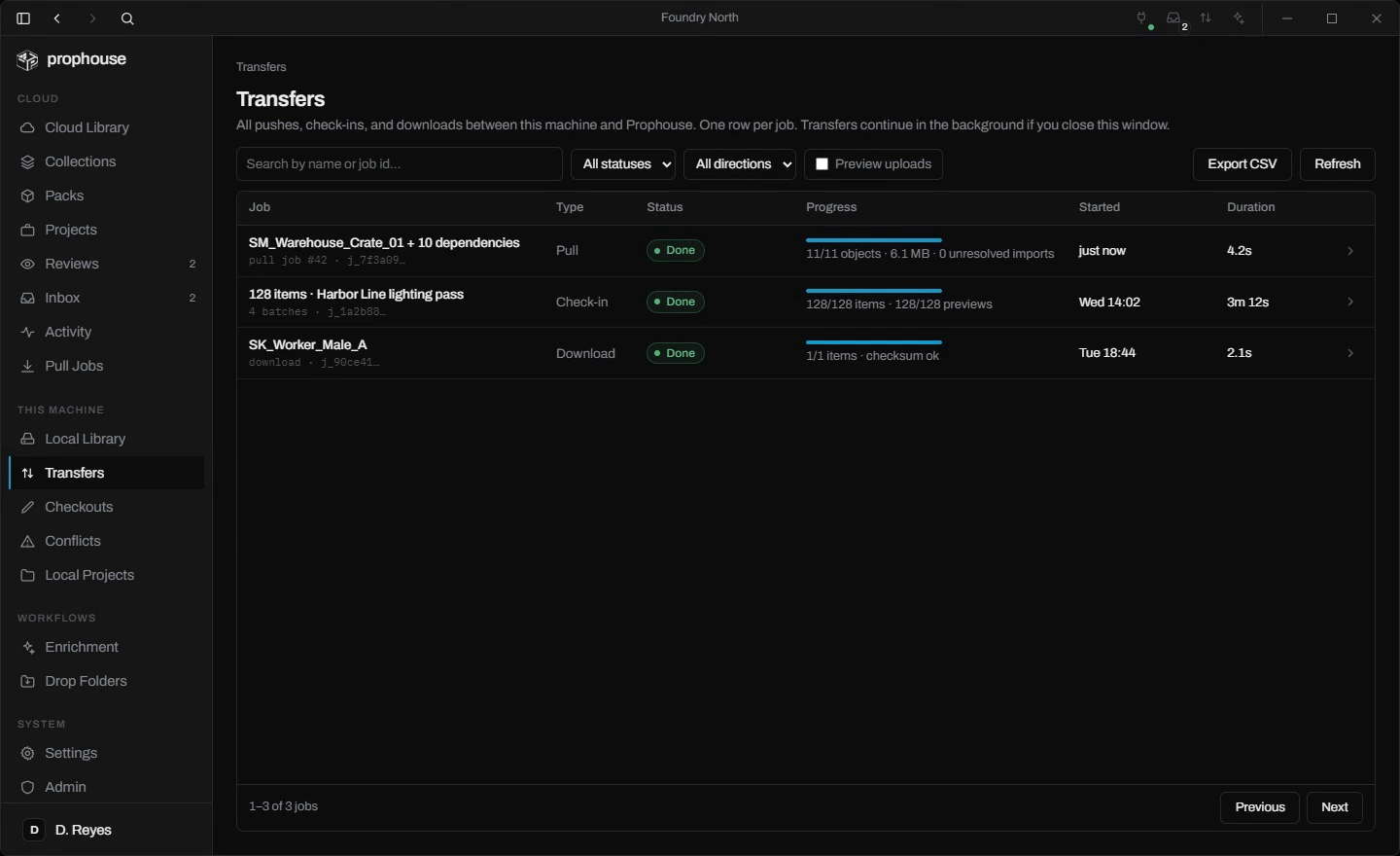
One click pulls an asset with everything it touches: materials, textures, the lot, laid out in a clean deterministic folder structure. Prophouse then re-scans what it wrote and reports zero unresolved imports before calling the job done. Anything less rolls the whole batch back.
If an incoming file collides with something you changed, it stops and asks. Closing the dialog keeps your version. Assets saved by a newer engine are blocked before a byte downloads, with every offender named.
Push from the Content Browser and close the editor.
Right-click any asset or folder and publish it, with its full dependency closure, as versioned catalog entries. The wizard shows what travels before anything moves, detects variant groups from your naming, and uploads only bytes the server has never seen.
Pushes chunk automatically at thousands of assets, uploads run twelve at a time straight to storage, and the desktop app carries the transfer once you commit. The push finishes whether the editor is open or not.
Locks the whole catalog can see.
Check an asset out from the browser tab and everyone sees who holds it, in the editor and in the app. Nobody pushes over your work, and no one ever merges a mesh.
Reviews ride along. Request sign-off on a version, draw on the preview, pin a note to the mesh itself, and when the verdict comes back it lands as a toast in the editor with a link to the round.
Your depot stays where it is. Prophouse doesn't ask to own your history or your file locks; it answers the question your depot was never built for: "which crate did we use in the alley scene?"
London pulls as fast as LA.
Assets are served from the network edge, close to every office and every remote artist. The outsourcer on another continent gets the same pull speed as the desk next to yours, and nobody tunnels into a file server across an ocean.
Reviews move at the same speed. A verdict drawn in one office lands in another's inbox seconds later, pinned to the exact version it judged.
Process the whole library without babysitting it.
Preview and thumbnail generation runs in a separate worker process, so a poisoned asset can't take the editor down. If the worker crashes, that one asset is quarantined by name and the run continues.
When the editor itself dies, Prophouse reads the crash report and tells you what happened. A GPU driver reset gets called a GPU driver reset, with receipts. A crash in our own code gets owned, with the culprit named.
The same workers run headless, so a build-farm machine can generate previews, thumbnails, and metadata overnight.
By the numbers.
unresolved imports after every pull, verified before success is reported
assets per push transaction, chunked automatically above that
parallel uploads, straight to object storage
metadata fields captured per asset, tri counts to Nanite
Runs where the studio wants it.
Hosted in our cloud, self-hosted on your own hardware behind your VPN, or air-gapped inside your network for the titles nobody is allowed to name. The desktop app keeps a local working copy in every deployment.
Your agents block out the level. Your library supplies it.
An agent dressing a set at 2 a.m. pulls from the same catalog your artists use at 2 p.m. Same search, same assets, same dependencies attached. See it work →
Try it on your real library.
Your first pack is searchable by sight in about four minutes, and it works with the Unreal Engine 5 projects you have today.