Describe it, or just show it.
The client circles a chair on a mood board. Somewhere in your archive is the model that matches, filed under a name nobody remembers. Drop the image in and Prophouse finds it by looking, then browses more like it with your filters still applied.
Plain English works the same way: "walnut credenza," "rattan pendant light," "wet cobblestone." The library is useful before anyone spends a week cataloging it.
Point it at the archive drive. It files itself.
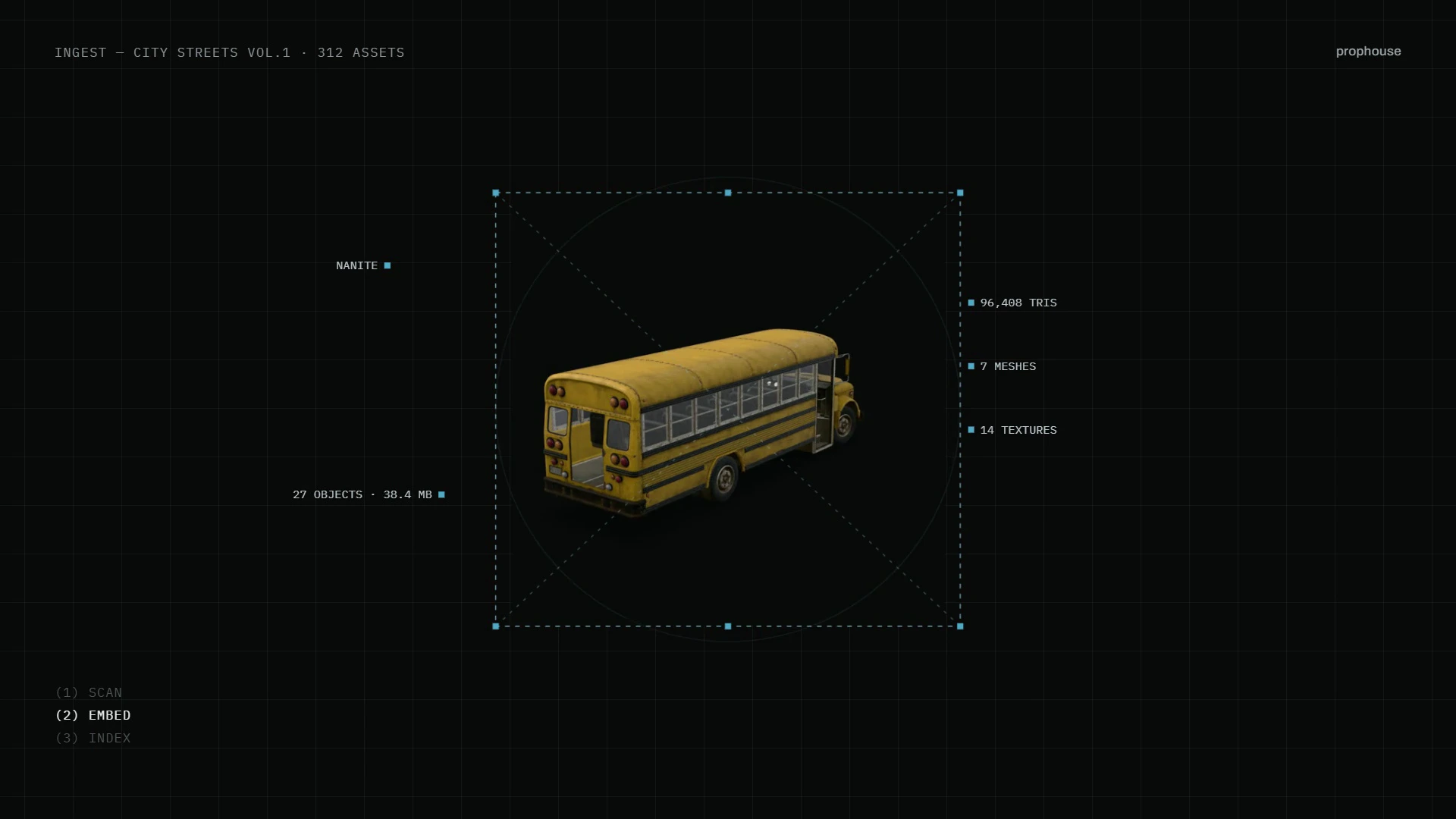
Add a drop folder and anything that settles there is cataloged: hashed, previewed, and staged for the library, with thumbnails and metadata generated on your machine. Models get orbiting turntable previews, textures get faithful renders, and it all becomes searchable by sight.
It reads what your pipeline already produces. FBX, OBJ, and glTF for models; EXR, HDR, TIFF, PSD, TGA, and DDS among eleven texture formats; WAV and three more for audio. Nineteen formats in all, straight from disk.
You own that chair three times.
Bought for one project, copied to the next, bought again by someone who couldn't find the first copy. Prophouse compares every asset by sight and flags the same model wherever it hides: across packs, across projects, across the drives of people who left. The duplicates surface side by side, with everything that uses each copy listed. You decide what stays.
Requested review on revision 3.
Fabric reads too glossy in the hero shot. Marked the highlight.
pin #1 · on the model · camera savedRoughness up, sheen pulled back. Re-requested.
That's the one.
Approval lands on the revision, in writing.
Request review and every response comes back in one round: approved, changes requested, and exactly which revision the verdict applies to. Spin the textured 3D model in the browser, draw on a render with pen, arrows, boxes, and text, or pin a note to a spot on the model with the reviewer's camera saved, so you see the sheen they saw.
@-mention a colleague and it reaches their inbox and their desktop. Every version of an asset is kept, restoring an older one takes one click, and "what did the client approve" always has an exact answer.
Some projects can't leave the building.
Government buildings, datacenters, stadiums: work where the assets and even the project's name sit under NDA. Run Prophouse behind your VPN or air-gapped on your own hardware, and licensed IP never leaves your network.
Teams without those constraints take the hosted version and never think about servers. The library works the same in every deployment, and the desktop app keeps a local working copy either way. How studios run it →
The library travels.
The desktop app keeps a local copy that answers offline: browse, search, and stage work from a site visit or a client meeting, and it syncs itself when you're back. An optional on-device index answers meaning and image searches against local files, with nothing uploaded anywhere.
For real-time work, the same catalog has an Unreal Engine 5 plugin: search from a panel in the editor and import a model with every material and texture attached, in one click. See the editor workflow →
Built for the archive you actually have.
file formats cataloged with previews, generated on your machine
texture formats, including EXR, HDR, TIFF, and PSD
reviewers per round, each verdict pinned to the exact revision
to move assets in or out, on every plan
Put your archive through it.
Point a drop folder at one project drive and see what ten years of purchases look like when they're searchable.